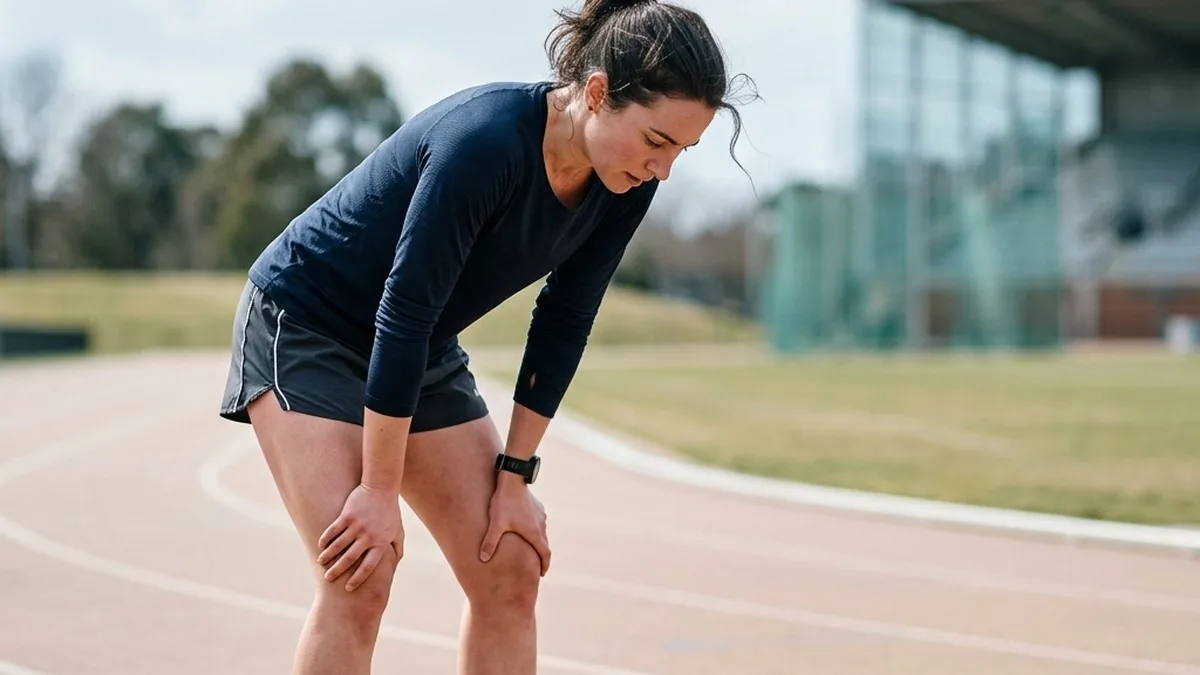
You did everything right. You cleaned up your diet, you're testing foods carefully, you're training hard — and then, mid-run or the morning after a heavy session, your gut cramps, your joints ache, or a wave of fatigue flattens you. And you're stuck on the same question everyone in your position asks: is it exercise or a food reaction? Was that the food you reintroduced yesterday, or just the workout catching up with you?
Here's the honest answer. When you're testing foods and training hard at the same time, you're running two experiments at once — and a symptom could belong to either. This is how you tell them apart instead of blaming the wrong one.
That "did everything right and still felt terrible" moment isn't a sign you failed. It's a sign you've got two variables moving together, and a single symptom can't tell you which one moved it. Exertion isn't a verdict on your food. It's a confounder — something you can actually control for once you know it's there. The rest of this article is about how to isolate the two, using timing, reproducibility, and a log instead of a guess.
Why Exercise Muddies Your Elimination Diet (the Two-Experiments Problem)
An elimination diet is, at its core, an experiment. You remove suspected triggers, then reintroduce them one at a time and watch what your body does. The whole method depends on one thing: when a symptom appears, you can reasonably tie it to the food you just tested.
Training breaks that assumption. Hard exercise produces its own crop of symptoms — muscle soreness, gut distress, joint ache, fatigue, even a transient skin flush from heat and blood flow. Those overlap almost perfectly with the symptoms you're watching for during a food test. So when your knees ache the day after you reintroduced dairy and the day after you squatted heavy, you're looking at a genuinely ambiguous signal. The ache is real. What caused it is the open question.
This is the two-experiments problem. You're testing a food and loading your body, often in the same 48-hour window, and each one can produce the same read-out. Attribute the symptom to the food and you might wrongly ban something you tolerate fine. Attribute it to the workout and you might keep eating something that's quietly working against you. Both errors cost you.
The fix isn't to stop training or testing foods — it's to stop treating exertion as invisible. Name the workout as a second variable and you can start pulling the two apart, because they leave different fingerprints.
Was It the Workout or the Food? Isolating the Two Variables
Two things produced one symptom. To know which, you need to make them disagree — to find a moment where the food says one thing and the workout says another.
That's the core move, and it rests on a simple idea: a food reaction tracks the food, and an exercise symptom tracks the load. They only look identical when the food and the hard session happen together. Separate them in time, or hold one steady while you change the other, and they start telling different stories. A food reaction shows up when you eat the food, whether you trained or not. An exercise symptom shows up when you load hard, whether you ate the suspect food or not.
You can't do that separation from memory. The reaction and the meal that caused it can sit days apart, and by the time your gut complains you've had several meals and workouts in between — human memory wasn't built to hold a rolling 72-hour ledger of food and training in parallel.
The only way to separate the two is to log both the workout and the food — every day, side by side, with timing. That's exactly what Carnivore Lifestyles is built to do: it tracks your meals, your training, and your symptoms in one place, so when a flare shows up you can see whether it lined up with a session, a specific food, or both. Start logging both variables and let the pattern surface instead of guessing at it.
DOMS vs Food-Driven Inflammation — the Timing Signatures
The clearest place to see the two fingerprints is muscle and joint symptoms, because delayed-onset muscle soreness and diet-driven inflammation run on different clocks and follow different rules.
The DOMS signature. Delayed-onset muscle soreness — the deep ache that sets in a day or two after a hard or unfamiliar session — typically peaks 24 to 72 hours after unaccustomed or heavy load. It has three tells worth memorising:
- Load-scaled. The harder or more novel the session, the worse the soreness. A brutal leg day or your first hill sprints in months produces it; an easy recovery jog usually doesn't.
- Bilateral and movement-specific. It lives in the muscles that actually did the work, usually on both sides evenly. Squats give you sore quads and glutes; a long downhill run gives you sore quads and calves. It doesn't wander into your gut or your skin.
- Predictable and self-resolving. It arrives on schedule after the session, plateaus, and eases over a few days without you changing anything you ate.
The food-driven signature. A symptom driven by a food you're reacting to behaves completely differently. It tracks the food, not the workout. It shows up in relation to what you ate, and — this is the decisive part — it reproduces when you re-expose to that food at rest, with no hard session anywhere near it. It also tends to travel with company DOMS never brings: bloating, loose stool, a skin flare, brain fatigue. If your "sore joints" arrive on a rest day after a specific meal, or show up with gut symptoms attached, that's not the mechanical signature of soreness — that's pointing at the plate.
Joint pain is the classic crossover case, because both a hard session and an inflammatory food can produce it, and telling muscle ache from joint inflammation is its own skill. We won't re-teach that here — our guide to joint pain and food triggers walks through the muscle-versus-joint and inflammation side in depth. The point for this article is narrower: soreness that scales with your training load and lives in the muscles you worked is wearing the DOMS fingerprint, not the food one.
Runner's Gut vs a Delayed Food Reaction — What the Window Tells You
Gut symptoms are the other big overlap, and here the timing window does most of the disambiguation work.
Start with the exercise side, stated once and carefully: heavy or prolonged exertion can transiently increase gut permeability. During hard effort, blood is shunted away from the digestive tract toward working muscles and skin — a temporary drop in gut blood flow called splanchnic hypoperfusion — and that short-lived stress on the intestinal barrier is a well-described part of what people call "runner's gut." The hedge matters — it can, not it always does — and the signature is that it's yoked to the session. Runner's gut shows up during or right after hard or long efforts — the cramps, the urgency, the nausea that hit at mile ten and settle once you stop and recover. If your gut only ever complains inside the exercise window and calms afterward, that's the exertional fingerprint.
A food reaction runs on a different timer. After a single exposure to a trigger food, non-immediate symptoms typically appear anywhere from a few hours to about 72 hours later, with the delayed (Type IV) hypersensitivity reactions classically peaking around 48 to 72 hours. That long tail is exactly why food reactions get misattributed to workouts — the gut distress you feel Thursday might belong to the reintroduction you did Tuesday, not the tempo run you did this morning.
And there's a second food pattern that's easy to confuse with adaptation: the cumulative one. It looks different, but it's the same mechanism — not a separate one. Your body has a personal threshold, and symptoms only show once enough trigger has stacked up to cross it, like filling a glass until it overflows. Two things set how fast the glass fills: how much of the trigger you eat, and how strongly you react to it. A large amount of a trigger — or even a normal amount of something you're highly sensitive to — can fill the glass in a single sitting, so symptoms land in the hours-to-72-hours window. A low-grade sensitivity, or small amounts eaten day after day, fills it slowly instead: each exposure stays under the line on its own, so nothing shows until the accumulated load crosses your threshold around day 3 to 7. This slow, daily version is the pattern most people on an elimination diet are actually living — quietly eating something every day that's slowly stacking up. (It's also why a small taste of a mild trigger on reintroduction can pass with no reaction at all — the glass never got full enough, so a "clean" result from a tiny portion isn't conclusive.) Same threshold; what changes is the dose and your sensitivity — which is why one number can't cover both.
The Isolation Protocol — How to Re-Test One Variable at a Time
Once you know the two fingerprints, you can design a test that forces the food and the workout to disagree. The whole trick is to change one variable while holding the other constant, so whatever happens next has only one plausible author.
There are two clean ways to run it.
Option A — hold training constant, change the food. Pick a genuinely easy, boringly consistent training day — the same low-intensity session (or a rest day) you can repeat exactly. Now do your food re-test against that flat background. Eat the suspect food on one such day; skip it on another otherwise-identical day. Because the training load is held still, a symptom that shows up on the food day and not the no-food day has the food's fingerprint on it. You've taken the workout out of the equation by refusing to let it vary.
Option B — hold the food constant, change the workout. Keep your food identical across two days — same meals, no reintroductions — but run one hard session and one easy session. If the symptom appears after the hard day and not the easy day, with the diet held flat, that's the exercise talking. Same food, different load, different outcome: the load is the author.
A few rules make either version trustworthy:
- Change one thing at a time. If you reintroduce a food and PR your deadlift on the same day, you've rebuilt the confounder you were trying to remove.
- Respect the delay. Watch the full window before you conclude. For a single food re-test, give it up to 72 hours; don't declare a food "safe" because you felt fine an hour later.
- Repeat before you rule. One clean result is a lead, not a verdict. Reproduce it — same food, same response, twice — before you trust it.
- A null result is still a valid result. If you re-test at rest and the symptom doesn't come back, that's real, useful information: it points away from the food and toward the load. "Nothing happened" is data, not a failed experiment.
This is the same disciplined re-testing logic that underpins any good elimination approach — our carnivore elimination diet guide covers the reintroduction method in full if you want the parent framework. The isolation protocol is that method with one addition: you're controlling for training load, not just food.
What the Log Should Show You
None of this works from memory — and it doesn't need to. What it needs is a record: food, training, and symptoms captured together with timing, so patterns you can't hold in your head show themselves on the page.
A useful log tracks all three streams side by side:
- Food: what you ate and when, including the extras that are easy to forget — the reintroduced test food, but also condiments, dairy, coffee, anything off-plan.
- Training: what you did and how hard — session type, intensity, duration, and anything unusually novel or heavy. That "unaccustomed load" note is what lets you predict a DOMS spike.
- Symptoms: what you felt, how bad (a simple 1–10 works), and — critically — when it landed relative to both the last meal and the last session.
Lay those three next to each other over a few weeks and the fingerprints start to separate on their own. You'll see soreness that reliably follows heavy days and lives in the worked muscles — the load pattern. You'll see gut distress that only ever shows up mid-workout and settles after — the exertional pattern. And you'll see the other kind: a symptom that tracks a specific food across exposures, reproduces at rest, and ignores whether you trained — the food pattern. That's the moment the guessing stops.
This is genuinely individual, and that's worth holding onto.
Tracking doesn't diagnose anything, and it isn't a treatment. It's a way to see connections you'd otherwise miss, so you can make your own calls with evidence instead of anxiety. The general principle that a demanding stretch can make an otherwise-tolerated food feel like a problem is one we cover more broadly in our guide to tracking an elimination diet; here, the specific culprit we're isolating is exertion.
Start Separating the Signal From the Sweat
If you've been staring at a symptom wondering whether it was the workout or something you ate, you now have a way to answer that isn't a coin flip. It's not the symptom — it's the pattern: the timing signature, the reproducibility at rest, and a log that holds food and training side by side so the two experiments stop bleeding into each other.
That's exactly what Carnivore Lifestyles is built for — logging your meals, your training, and your reactions in one place so the pattern surfaces instead of staying a mystery. Start your free 14-day trial — no credit card required — and find out which experiment your symptom actually belongs to.
Frequently Asked Questions
Is it exercise or a food reaction — how can I tell the difference?
Look at the fingerprints. An exercise symptom tracks your training load: muscle soreness that peaks 24 to 72 hours after a hard or unfamiliar session, lives in the muscles you worked, and scales with how tough the workout was. A food reaction tracks the food instead — it reproduces when you eat that food again at rest, often shows up on a delay, and tends to bring gut, skin, or fatigue symptoms with it. The reliable way to separate them is to hold one variable steady while you change the other, and to log both so you can see which one moved.
How long after a workout does DOMS usually last?
Delayed-onset muscle soreness typically peaks 24 to 72 hours after the session, then eases over the following days without you changing your diet. It's load-scaled (worse after heavy or novel training), bilateral, and confined to the muscles you actually trained. If your soreness scales with your workouts and stays in the worked muscles, that's the DOMS signature — not a food.
How long can a food reaction take to show up?
It depends on the dose and your sensitivity — but it's one mechanism, not two. Symptoms appear only once enough trigger has crossed your personal threshold. A large amount, or something you react to strongly, can get there from a single exposure, so symptoms land within a few hours to about 72 hours (delayed hypersensitivity often peaks around 48 to 72 hours). A low-grade sensitivity eaten daily gets there slowly instead — the load builds until it becomes noticeable around 3 to 7 days in. Same threshold, reached faster or slower. That delay is exactly why food reactions get blamed on the nearest workout.
Can hard exercise cause gut symptoms on its own?
It can. During hard effort, blood is diverted from the gut toward working muscles (splanchnic hypoperfusion), which can briefly stress the intestinal barrier. The tell is that it's tied to the session — cramps or urgency that hit during or right after long, intense workouts and ease once you recover. If your gut only ever complains inside the exercise window, that points at the workout, not the plate.
I just started carnivore and feel rough — is that a food reaction?
Not necessarily. Your gut adapts to a big dietary change, and early-transition symptoms often fade over the first weeks. Early-adaptation discomfort isn't a permanent verdict on a food. It's worth re-testing a suspect food later, at rest and away from a hard training block, before you decide it's a genuine trigger — and a null result on that re-test is a valid, useful answer.
References
1. Cheung K, Hume PA, Maxwell L. 2003. Delayed onset muscle soreness: treatment strategies and performance factors. Sports Medicine, 33(2):145–164. PMID: 12617692.
2. Costa RJS, Snipe RMJ, Kitic CM, Gibson PR. 2017. Systematic review: exercise-induced gastrointestinal syndrome — implications for health and intestinal disease. Alimentary Pharmacology & Therapeutics, 46(3):246–265. PMID: 28589631.
3. van Wijck K, Lenaerts K, Grootjans J, et al. 2012. Physiology and pathophysiology of splanchnic hypoperfusion and intestinal injury during exercise. American Journal of Physiology — Gastrointestinal and Liver Physiology, 303(2):G155–G168. PMID: 22517765.
4. Caubet JC, Szajewska H, et al. 2018. Non-IgE-mediated gastrointestinal food allergies in children. Allergy, Asthma & Clinical Immunology. PMC6157279.
5. NICE Clinical Guideline CG116. Food allergy in under 19s: assessment and diagnosis. (Non-IgE reactions: 1–72 hours.)
6. Lietz A, Dapprich J, Fischer T. 2026. Carnivore Diet: A Scoping Review of the Current Evidence, Potential Benefits and Risks. Nutrients, 18(2):348. doi:10.3390/nu18020348. PMID: 41599961. PMC12845189.
Medical disclaimer: This article is for educational purposes only and does not constitute medical advice. Always consult with a qualified healthcare professional before making significant dietary changes, particularly if you are managing a diagnosed medical condition, taking prescribed medication, or have a history of disordered eating. The carnivore or animal-based elimination approach involves significant dietary restriction — appropriate professional supervision is especially important for anyone with a history of nutritional deficiency, kidney disease, or cardiovascular conditions. Symptoms discussed in this article can have multiple causes, some of which require specific medical management. If you suspect a true food allergy (especially one causing severe or anaphylactic reactions), seek evaluation from a board-certified allergist. For pet dietary changes, always work alongside a qualified veterinarian.